
Author: mumblingofaminister

  • A Quiet Strength 

    A Quiet Strength 

    When visitors couldn’t visit; the Chaplains did.  When the nurses, Doctors and all other clinical staff were run off their feet; so were the chaplains. When working meant donning goggles, N-95 masks, face shields, gloves, and gowns the Chaplains dutifully did so.  When the paid hours were completed but need for visiting continued; the Chaplains remained.   

    It isn’t the hours of training, most having completed 1800 clinical hours and years of post-graduate studies, which set Chaplains apart.  It is their quiet yet humble presence that speaks the loudest.  They are the ones who pull up a chair and sit by the beds of the dying, ill, or scared, gently crafting meaning, peace and companionship. They are the ones who step in when all others have left. 

    To listen deeply to the needs of others; listening not only for what is spoken but for that which is left unspoken takes time, patience and a trained ear.  To understand the importance of stillness, quietude and presence is to know that healing happens in various and unseen ways.   

    There is a gross miscalculation of the necessity for Chaplains by many in positions of authority in healthcare settings today.  We know this to be true with the elimination of most Chaplain Positions across Grey-Bruce.  These cuts happened without any conversation, consultation or public awareness.  Some healthcare settings eliminated Chaplains entirely while others have kept Chaplains with just enough hours to fringe on tokenism; fulfilling minimum Accreditation requirements.

    If you have ever been blessed by the presence and care of a Chaplain in a local healthcare setting, then offer a prayer of gratitude for what they offered.  It has been a difficult time for local Chaplains and all prayers would be appreciated.

    Blessings,

    Rev. Heather McCarrel (BA, MDiv & Spiritual Care Provider/Chaplain)

    Photo by Jon Tyson/Unsplash

  • Happy Mother’s Day

    Happy Mother’s Day

    Mother’s Day has come around again.  In seminary we were taught that these “Hallmark Holidays” were more about turning a profit for big business than genuine sentiment.  That wasn’t the way it started; Mother’s Day has an honest beginning.

    Anna Jarvis of Philadelphia, whose mother had organized women’s groups to promote friendship and health, originated Mother’s Day. On May 12, 1907, she held a memorial service at her late mother’s church in Grafton, West Virginia. Within five years virtually every state was observing the day, and in 1914 U.S. Pres. Woodrow Wilson made it a national holiday. (Britannica)

    There is a tradition that on Mother’s Day one wears a flower pinned to their lapel in honour of their mother.  The tradition holds that a white flower indicates if one’s mother has died, and a red or pink flower tells of a mother who is still alive. 

    Sadly, I find myself wearing a white flower on Mother’s Day.  I miss my mom daily and am grateful that her wisdom and lessons remain with me.   

    This past week I had the opportunity to visit with two lovely women from the church I serve.  Each knows the depths of grief that comes from the deaths of their spouses, and each has lived through the hardships of life.  They both are advanced in years and can fondly remember days of better health and of happier times.  And yet, each visit was filled with laughter and conversation that never turned dull or negative.  These are not the type of women who spend time in gossip or judgement of others. Instead, I heard of future vacation plans, gardens planted and family gatherings.  The time flew with each visit.

    As I reflected on both women, I realized they each model nurture to me and remind me of my own Mother and Grandmothers.  Their laughter, hospitality and wisdom mark the way I want to travel as I grow in years.  I too would like to be a beacon of nurture to younger women and be one who shares joy, acceptance, and grace that they each modelled for me.

    This Mother’s Day I thank God for the mother I had and for all those that still nurture the world with their care, grace, and laughter.

    Happy Mother’s Day,

    Rev. Heather McCarrel  

    Photo by George Dolgikh/Pexels

  • When Healing Doesn’t Come

    When Healing Doesn’t Come

    One of my favorite pastimes as a child was to go roller skating around the neighborhood.  My skates were two metal frames with four metal wheels that would buckle onto the soul of my running shoes. They did not have a rubber stop so when it came time to stop, I would throw myself down on the grass or against a tree.  Needless to say, I spent most of my summers with bandaged knees!  Eventually the wounds would scab over and before I knew it my knees were back to normal.  I took for granted that healing would always come.

    A couple of months ago I had a somewhat simple procedure performed on one of my knees.  The surgeon had said that within 6 to 8 weeks I would be back to normal.  Well, six weeks has come and gone and still my knee isn’t functioning like it should.  A few unexpected complications have delayed the healing. In my frustration I called out to God, demanding strength, patience and a pain free day.  

    In the Gospel of Mark there is a story of Jesus healing Samuel’s ill Mother-in-law followed by Jesus healing all kinds of people (Mark 1:29-34).  The story seems to imply that so long as you reach out to Jesus in faith, your healing will come.  The opposite truth being, if you do not receive healing, it must be a sign of some weakness in your faith.

    But we know that eventually healing didn’t come to Samuel’s Mother-in-law.  The same is true of all those Jesus healed; a day arrived when each and every one of them died.  Eventually, healing does not come.

    What do we do when the healing doesn’t come?  We all know those moments when our pain seems to increase and resilience seems impossible.  What do we do when all seems to fail?

    We do exactly what Jesus did. 

    In the same passage in the Gospel of Mark, after healing hundreds of people, Jesus went off alone to pray (Mark 1:35).  He knew that when we feel depleted, there is one who is always ready to listen, to offer peace and to make whole that which seems broken.  We are reminded to “Draw near to God and God will draw near to you.” (James 4:8 NKJV)

    May we always believe in God’s eternal plan, trusting in the one who sees beyond any of our limited horizons. 

    Blessings,

    Rev. Heather McCarrel

    Photo by Lukas Rychvalsky/Pexels

  • Defense Against The Darkness

    Defense Against The Darkness

    Early every November, when the days are short and nights are long, I gather all that is needed to create my defense against the darkness.

    It usually entails one trip to the local hardware store, old newspapers from the recycling bin and about 2 hours of my time.  With the kitchen counter cleared and covered with the old newspapers I begin this most necessary task.

    It is a dirty task but one that raises my spirits like no other on a dark November evening.  The repotting of my house plants!

    I lovingly choose which of my growing collection needs a bigger or deeper pot and with tender words of encouragement the procedure begins.  Once the new pot is prepared, I delicately lift the plant out of its old digs and gingerly place it within the folds of freshly fluffed soil.  The roots are carefully covered followed by the gentle cleansing of each leaf.  Once complete, fresh water is poured over the soil and misted across the foliage. Then that plant is returned to its place within our home looking refreshed and standing a bit prouder.

    My home is full of green plants, some hanging from the windows, others along windowsills or in planters.  We have an arrangement, me, and these green roommates.  They promise to filter the air in our home filling the grey November days with many shades of green; shades that provide a peacefulness that both comfort and enliven my spirit.  I in return visit each one weekly nourishing them with loving words, fresh water and at times some liquid food.

    As the quote says, “Having indoor plants is like having little pockets of joy throughout your home.”  These pockets of joy are truly a gift from God!

    Blessings,

    Rev. Heather McCarrel

    Photo by Huy Phan/Pexels

  • Silent Beauty

    Silent Beauty

    Dr. Maria Montessori, an Italian physician and educator best known for her philosophy of education, taught the value of silence to her young students.

    In her book, The Secret of Childhood, she explains that one day she carried a sleeping infant into a busy classroom and all the students quieted down to observe the peacefulness of the infant.   This silence became a game in her classroom and it wasn’t long until the children grew to appreciate all that silence brought, “Silence is refreshing, giving our overloaded senses a break. When it is silent it is easier to notice how smooth the geometric solid is in our hands. It is easier to hear the gentle sound of a zipper, or notice the scent of fresh cut flowers. Silence brings us back into ourselves, yet is also a profound connection to everyone else in the room at the same time.”

    It isn’t unusual to find plants and flowers in a Montessori classroom, each used as a lesson in how beautiful things happen in silence, “Watch as the flower blooms in complete silence or how that green plant grows up the side of the window in utter silence.” The same is true when appreciating a sunrise or a sunset, each taking our breath away without making one bit of sound.

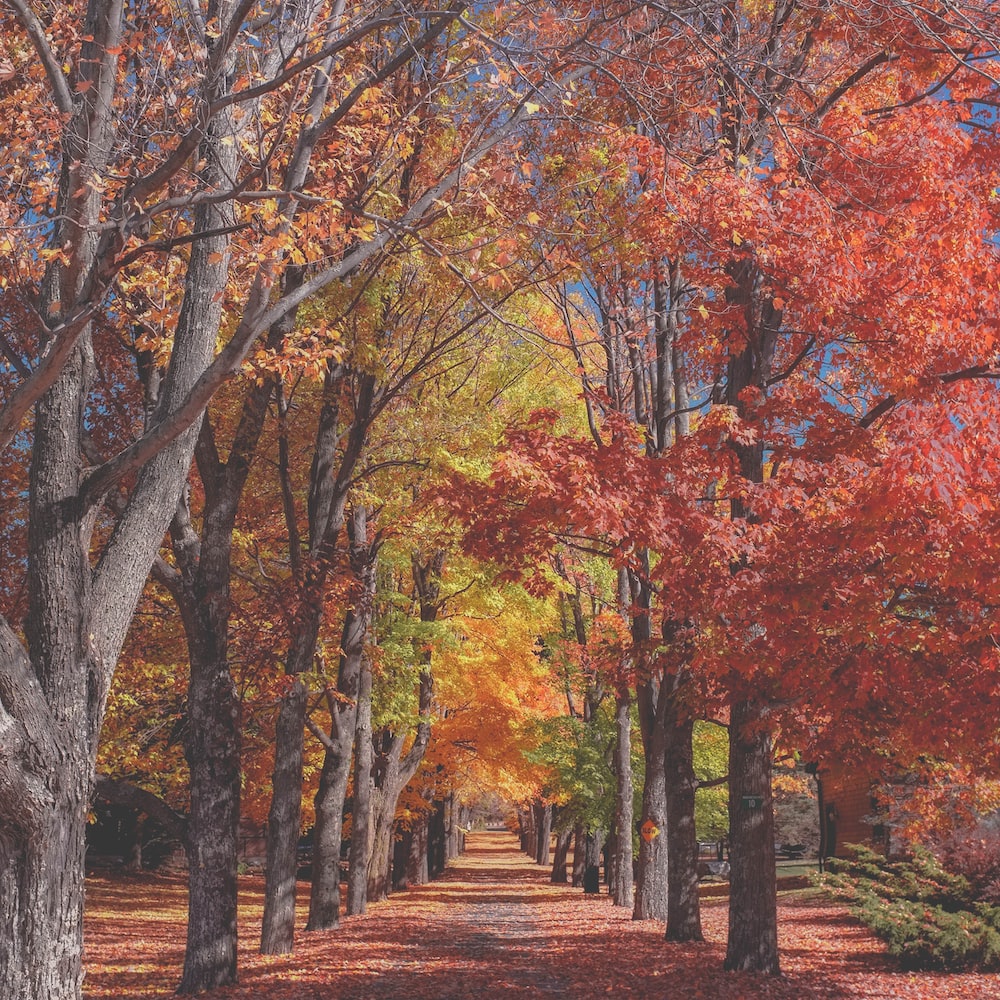
    Autumn is a wonderful example of God’s beauty in silence.  The silent trees fill the landscape with a brilliant celebration; bright yellows, jubilant oranges, and rapturous reds, awing us into a silent reverence.

    May we take this lesson and like Dr. Montessori and her students, savor all that silence can teach us.

    Blessings,

    Rev. Heather McCarrel

    Photo by Courtney Read/Unsplash

  • Feisty But Adorable Neighbors

    Feisty But Adorable Neighbors

    As the end of September draws near I know the time has come to do one of my least favorite tasks; turning over the vegetable garden.

    Despite the baskets of vegetables this year’s harvest supplied, I still find it difficult to pull up plants that show the smallest hope of bearing new fruit. 

    As I stood by the garden on this chilly but bright morning it seemed the beans, now wandering way above my head, deliberately stretched to their fullest revealing the tiny new beans.  The tomato plants gleamed with a certain shine as the morning light danced off their many tiny green gems and the spinach was more thick and lush then I had remembered, tempting me to just return inside.

    Twice over the past few weeks I had headed out with plans to pull up the garden and twice I had returned inside; today had to be different. Today I must be tough and get the task done.

    Whispering an apology I began to pull up the small plants then made my way around to the tall beans and peas.  Once they were lying in heaps by the composter I returned to the tomato plants.  It was then I heard angry banter from one of my neighbors.  He made it clear that he wasn’t pleased with what I was doing.  His protests went from a harsh tongue lashing to throwing pine cones at me! 

    He sent down a few warning pine cones which loudly banged off of the metal roofed shed echoing throughout the yard.  I stopped, looked up and this little red squirrel stood on the edge of the tree bough twitching its tail in a rather threatening manner.    

    I laughed at his tenacity; but he wasn’t amused and with little effort, dropped a pine cone right in my direction. At this point my dog, who had been napping, joined me by the garden.  Together we stood looking up as pine cones rained down around us.

    It would seem this tiny neighbor was very invested in the continued growth of my vegetable garden. Perhaps it was his high pitched “tit-titching” of me or his tense but adorable stance, but I decided to take his advice and the tomato plants still stand. As I gathered up all the garden tools and began to tidy up around the garden he quieted down and by the time I turned to go inside he was silent. 

    It wasn’t until an hour later I looked out the kitchen window and found this exasperating neighbor standing on the wooden edge of the raised garden enjoying a small green tomato.  I swear, he turned looked me straight in the eye and smiled as he continued to enjoy his lunch!

    May we all be blessed by feisty but adorable neighbors,

    Rev. Heather McCarrel

    Photo by Gael Dupont-Langexin/Pexels

  • Heading Back…

    Heading Back…

    It is Labour Day Weekend, the weekend of ‘heading back’.  Students are preparing this weekend for ‘heading back’ to school, teachers are prepping for ‘heading back’ to teaching, those fortunate enough to have taken extended holidays will be ‘heading back’ to work.  Just about everyone, retired or otherwise, will be ‘heading back’ into a busy autumn season.

     I wonder if we shouldn’t pause and consider what this ‘heading back’ should look like.   Should we be ‘heading back’ head first into the same exhausting pace that sent us away for a rest?  Perhaps we could ‘head back’ in a way that fills us with purpose, energy and enthusiasm?

    This long weekend affords us a few extra hours to ask ourselves, “What do I value most in life? Are these values reflected in the busyness of each ordinary week day?”  “What do I want the sum of my days to amount to?” 

    Our values direct our days and define the purpose in our lives.  By deliberately considering what we value we begin to take control of the activities, people and busyness that fill our days.  Without this deliberate focus our days are devoured by meaningless pursuits which leave us soulfully exhausted.

    Once we discover our top values we then have a frame work in which to place the moments of our days.  For example, if peace of mind or time with family top our value list, then perhaps we would think twice about whose company we keep, how many extra commitments we make and how we spend our leisurely time. 

    Taking time to consider what we value most is like resetting the compass of our life, it will result in a life directed toward enthusiasm, purpose and peacefulness.   

    As John C. Maxwell writes, “Your core values are the deeply held beliefs that authentically describe your soul.”   May we all ‘head back’ soulfully prepared.

    Happy Labour Day,

    Rev. Heather McCarrel

    Photo by Estee Janssens/Unsplash

  • World House

    World House

    Some years ago, a famous novelist died. Among his papers was found a list of suggested plots for future stories, the more prominently underscored being this one: “A widely separated family inherits a house in which they have to live together.” 

    This is the great new problem of our time.  We have inherited a large house, a great ‘world house’ in which we have to live together-black and white, Easterner and Westerner, gentile and Jew, Catholic and Protestant, Muslim and Hindu-a family unduly separated in ideas, culture and interest who, because we can never again live apart, must learn somehow to live with each other in peace. (Martin Luther King, Jr’s introduction to his talk, “The World House”)

    The world’s religions all agree it isn’t complicated to live in peace, simply “Do unto others as you would have them do unto you.”  Jesus simplified it even more, “love thy neighbour as thyself” (Matthew 22:37–39).   

    Who is our neighbour?  Anyone beyond ourselves. 

    Author Saul Bellows tells the story of a rabbi in a small village who mysteriously disappeared every Friday.  It was whispered, and the villagers sincerely believed, that on those days he ascended to Heaven itself.  A newcomer to the village heard this and was extremely skeptical.  So, making sure he was not seen, he stealthily followed the rabbi one Friday.  He saw the rabbi change into the clothes of a peasant.  Then, carrying an axe, he went into a nearby forest where he cut down a tree. He cut the tree into fire logs.  Gathering enough for a week’s burning he took them to the home of an old and frail woman.  After that, he returned to the village, changing back into his usual clothes. 

    And ever afterwards, when the villagers declared that every Friday their rabbi ascended to Heaven, the newcomer would say under his breath, “If not higher.”

    May we all ascend higher than heaven by our daily selfless acts of caring for our neighbours.

    Blessings,

    Rev. Heather McCarrel

    Photo by Priscilla Du Preez/Unsplash  

  • The World House  

    The World House  

    Some years ago, a famous novelist died. Among his papers was found a list of suggested plots for future stories, the more prominently underscored being this one: “A widely separated family inherits a house in which they have to live together.” 

    This is the great new problem of our time.  We have inherited a large house, a great ‘world house’ in which we have to live together-black and white, Easterner and Westerner, gentile and Jew, Catholic and Protestant, Muslim and Hindu-a family unduly separated in ideas, culture and interest who, because we can never again live apart, must learn somehow to live with each other in peace. (Martin Luther King, Jr’s introduction to his talk, “The World House”)

    The world’s religions all agree it isn’t complicated to live in peace, simply “Do unto others as you would have them do unto you.”  Jesus simplified it even more, “love thy neighbour as thyself” (Matthew 22:37–39).   

    Who is our neighbour?  Anyone beyond ourselves. 

    Author Saul Bellows tells the story of a rabbi in a small village who mysteriously disappeared every Friday.  It was whispered, and the villagers sincerely believed, that on those days he ascended to Heaven itself.  A newcomer to the village heard this and was extremely skeptical.  So, making sure he was not seen, he stealthily followed the rabbi one Friday.  He saw the rabbi change into the clothes of a peasant.  Then, carrying an axe, he went into a nearby forest where he cut down a tree. He cut the tree into fire logs.  Gathering enough for a week’s burning he took them to the home of an old and frail woman.  After that, he returned to the village, changing back into his usual clothes. 

    And ever afterwards, when the villagers declared that every Friday their rabbi ascended to Heaven, the newcomer would say under his breath, “If not higher.”

    May we all ascend higher than heaven by our daily selfless acts of caring for our neighbours.

    Blessings,

    Rev. Heather McCarrel

    Photo by Priscilla Du Preez/Unsplash  

  • Night Calls

    Night Calls

    It was in the wee hours of the morning that they woke me.  At first, I wondered if I had dreamt it but as I lay awake their calls filled my darkened room.  Getting up and quietly pulling on my slippers I leaned against the open screen and listened more deliberately.

    Sure enough, they were out there.  Not one but most likely two or more owls screeching and hooting; each marking their territory.  Carefully I opened the door to the patio and slipped out unnoticed.  I wanted to enjoy their conversation for as long as I could.

    Their hollow hoots took me back to a night many years earlier in the same back yard.  We all were gathered around a camp fire and my three young children, no older than 9 or 10, heard an owl for the first time.  As we silently listened to the haunting call the camp fire flames danced in the night creating a most desired effect; it was a night we won’t forget.  The awe I felt that night returned as I now sat alone listening deeply from the back deck.

    Earlier that night I had prayed asking for words, the kind of words a minister is to preach on a Sunday following a week of terrible headlines. That week we had witnessed wild fires strip thousands of acres of land, homeless people pitch make shift tents in city centres, random stabbings on the Toronto subway, and locally we had the deaths of two young promising youth.

    These owls had arrived to answer that very prayer.  Their timelessness reminded me of God’s great mystery, awe, and eternal presence.   

    As the owls flew away leaving behind the wind whispering through the pine trees I knew I had my answer.  As First Nation’s writer, Richard Wagamese once wrote, “I know that the price of faith is the courage to walk through anything with belief in immaculate love-and the value of faith is eternal.” 

    There is eternal value in trusting God’s love, participating in the great mystery and remaining open to God’s un-chartable awe.

    Blessing,

    Rev. Heather McCarrel

    Photo by Erik Karits/Pexels